
China, the world's second largest auto market, will slash import taxes on cars and auto parts from July 1 to comply with Beijing's commitment to the World Trade Organisation.
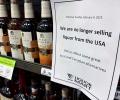
'We have to be prepared for the larger disruption that is likely to take place.'
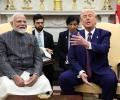
Deferment or rescheduling of the meeting assumes significance as the US has announced a staggering 50 per cent duty on Indian goods.

India's exports contracted 11.8 per cent to $34.38 billion in October, showed government data released on Monday. Imports jumped 16.63 per cent to $76.06 billion.
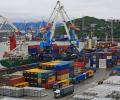
The escalating trade war between the US and China is expected to benefit Indian exporters in increasing their shipments to the American market, according to experts. Federation of Indian Export Organisations (PTI) President S C Ralhan said that imposition of higher tariffs by the US on China will shift demand towards India, which exported goods worth Rs 86 billion to the US in 2024-25.

The commerce ministry is working on different scenarios to assess the possible fallout of reciprocal tariffs to be imposed by the US administration on April 2 on its key trading partners including India, sources said. US President Donald Trump has said that April 2 will be 'Liberation Day' as he plans to announce tariffs or import duties to bring down America's trade deficit, and promote the country's manufacturing.
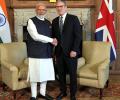
For UK automakers, market access to India will be limited by quantity caps and phased tariff cuts, especially on petrol, diesel and electric vehicles.
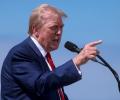
Essential and strategic items such as pharmaceuticals, semiconductors, copper, and energy products like oil, gas, coal and LNG are exempted from the 27 per cent import duty announced by the US on Wednesday, according to think tank GTRI.
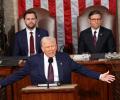
Trump has made it clear to Prime Minister Modi that India will not be spared from Washington's reciprocal tariffs and emphasised that "nobody can argue with me" on tariff structure.

The Reserve Bank of India (RBI) on Friday delivered a 25 basis point (bps) repo rate cut analysts expected, driven by the strong 8.2 per cent GDP growth in the September quarter. However, analysts do not expect a runaway market rally as the impact of US tariffs continues.
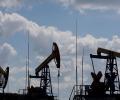
Two days after Russian President Vladimir Putin concluded his visit to India, during which he assured that Moscow would remain a reliable energy supplier, the Kremlin on Monday said that India, as a sovereign nation, is free to buy oil from sources it deems beneficial. It expressed confidence that New Delhi will continue to prioritise its economic interests.

As the rupee remains under pressure due to several headwinds and the uncertainty around the India-US trade deal, the Reserve Bank of India (RBI) has been stepping in only to calm volatility, not to stop the fall.
"I am telling you, these countries are calling us up, kissing my a***," Trump said during a speech at the National Republican Congressional Committee dinner on Tuesday.
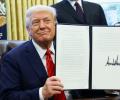
The Trump trade shock is a chance to push long-overdue reforms, rather than tinker with tariffs to appease the US, suggests M Govinda Rao.
'As negotiations continue, the path forward demands not only diplomatic skill, but also vigilance against legal asymmetries embedded in America's trade playbook.'
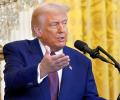
Trump met with his trade team on Tuesday, and the tariffs he announces at a Rose Garden ceremony at 4 pm ET Wednesday will go into effect "immediately," White House Press Secretary Karoline Leavitt said at a press briefing.
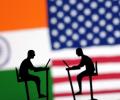
The US is expected to push for sweeping changes in India's policies, ranging from tariff reductions to regulatory overhauls, that could benefit American firms and exporters, under the proposed bilateral trade agreement with India, think tank GTRI said on Sunday.

From the Sensex firms, Hindustan Unilever, Kotak Mahindra Bank, Trent, Reliance Industries, Asian Paints and ITC were among the gainers. However, Bharat Electronics Ltd, Tech Mahindra, UltraTech Cement, Maruti and Eternal were among the laggards.
US President Donald Trump has proposed a deal to China that would see the sale of TikTok's US operations to an American buyer in exchange for a reduction in tariffs on Chinese exports to the US. The proposal comes amid a trade war between the two countries and follows China's retaliation of Trump's tariffs on Chinese goods. Trump has also said that tariffs are a powerful economic tool and that he is determined to ensure fair trade between the US and China.

India offset the decline in exports to traditional destinations by sharply ramping up shipments to Jordan (18,086 per cent), Hong Kong (17,006 per cent), Spain (13,436 per cent), the Philippines (2,235 per cent), and Namibia (1,068 per cent) in H1FY26.
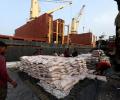
The government on Wednesday approved two schemes worth Rs 45,000 crore to help exporters tide over the impact of high tariffs imposed by the US on Indian shipments.

India's policy for agriculture trade must move commodity-by-commodity to gain maximum benefits as US President Donald Trump's 26 per cent tariff on exports from the country take effect, said agriculture economist Ashok Gulati in a recent policy paper.
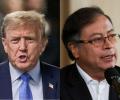
US President Donald Trump has imposed tariffs and a travel ban on Colombia after the South American nation refused to accept two American military planes deporting undocumented Colombians. The move comes after President Trump announced mass deportations of illegal immigrants and warned countries of consequences if they refuse to accept them. Colombian President Gustavo Petro, in a post on X, said that the US cannot treat Colombian migrants as criminals and denied the entry of American planes carrying Colombian migrants into Colombian territory. Trump responded by imposing a 25% tariff on all goods coming into the US, a travel ban and immediate visa revocations on Colombian government officials, and visa sanctions on all party members, family members and supporters of the Colombian government. The US also announced enhanced customs and border protection inspections of all Colombian nationals and cargo on national security grounds. In retaliation, Colombia announced a 25% import tariff on American products.
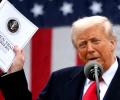
India does not do trade agreements in a hurry or with a "gun to our head", Commerce and Industry Minister Piyush Goyal said on Friday. He said India is actively negotiating trade pacts with countries and regions, including the European Union (EU) and the US.
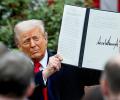
India is already negotiating a bilateral trade agreement with the US. The two countries are aiming to finalise the first phase of the pact by fall (September-October) of this year.
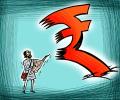
The rupee plunged 26 paise to an all-time low of 90.75 against the US dollar in intra-day trade on Monday, weighed down by uncertainty over an India-US trade deal and persistent foreign fund outflows.
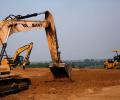
The Indian government should urgently consider imposing safeguard or anti-dumping duties on imports of two construction equipment segments - crawler excavators and tower cranes - as Chinese companies are rapidly expanding their presence in these markets in India through 'predatory' pricing supported by lower raw material costs, substantial export subsidies, and extended credit schemes, said Sorab Agarwal, executive director at Action Construction Equipment (ACE).
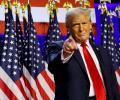
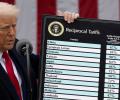
American President Donald Trump has announced imposing reciprocal tariffs on its major trading partners including China that levy higher import duties on goods shipped from the United States. He has already announced a 25 per cent duty on steel and aluminium imports, which will come into effect from March 12.
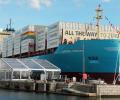
After US President Donald Trump announced a 90-day tariff pause for several nations, including India, global manufacturers are in a rush to ensure that bulk of their goods reach the US during this window. "The 90-day suspension of tariffs will be welcomed by shippers, but it should not be a cause for celebration.
India's exports grew 6.74 per cent to $36.38 billion in September, while imports jumped 16.6 per cent, widening the trade deficit to $31.15 billion, the highest in over a year. The increase in inbound shipments of gold, fertiliser and silver has pushed the country's imports in September to $68.53 billion against $58.74 billion in the same month last year, official data released on Wednesday showed.

Union Minister Nitin Gadkari states that countries engaging in bullying do so because of their economic strength and technological advancement. He emphasized the need for India to increase exports and reduce imports to achieve global leadership.

RSS chief Mohan Bhagwat clarifies the organization's role, stating it is not a paramilitary group and aims to unite society with virtues to prevent foreign subjugation.
With US President Donald Trump "temporarily suspending" country-specific reciprocal tariffs until July 9, India sees the three-month window as an opportunity to renew its push for a proposed bilateral trade agreement (BTA) with the US and expedite finalisation of the first tranche of the trade deal.

Kwatra termed India's successful launch of an American communication satellite on Wednesday as a 'very important and big day' for partnership between Washington and New Delhi, saying it caps a series of achievements in 2025 in bilateral space cooperation between the countries.
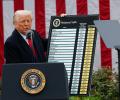
Amid the tumbling stock market in the United States, following the White House clarification of tariffs on China to be at least 145 per cent and an earlier announcement of a 90-day pause on tariffs for over 75 countries, President Donald Trump addressed the challenges associated with his tariff policy, stating that there would be 'transition problems'.

While gold continues to provide safety after its strong 2025 rally, well-chosen real estate investments held with a long-term view remain attractive.
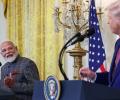
Of Trump's reciprocal tariffs and trade deals

A US official has stated that India's continued purchase of Russian oil is a point of contention in the relationship between the two countries, as it helps fund Russia's war efforts in Ukraine.

In 2025, India launched Operation Sindoor, a multi-domain combat mission against Pakistan in response to cross-border terrorism. The operation involved precision strikes, military retaliation, and diplomatic measures, marking a significant shift in India's security policy.

The Reserve Bank of India (RBI), in its Financial Stability Report (FSR), cautioned that stress tests indicate two scheduled commercial banks (SCBs) may have to dip into their capital conservation buffers (CCBs), unless stakeholders infuse capital, under a scenario involving a gradual slowdown in domestic GDP growth and a moderate rise in inflation, with limited policy easing space available to the central bank.
 © 2026 Rediff.com - Advertise with us - Disclaimer - Privacy Policy - Sitemap - Feedback - About us - Terms of use - Grievances